How it works
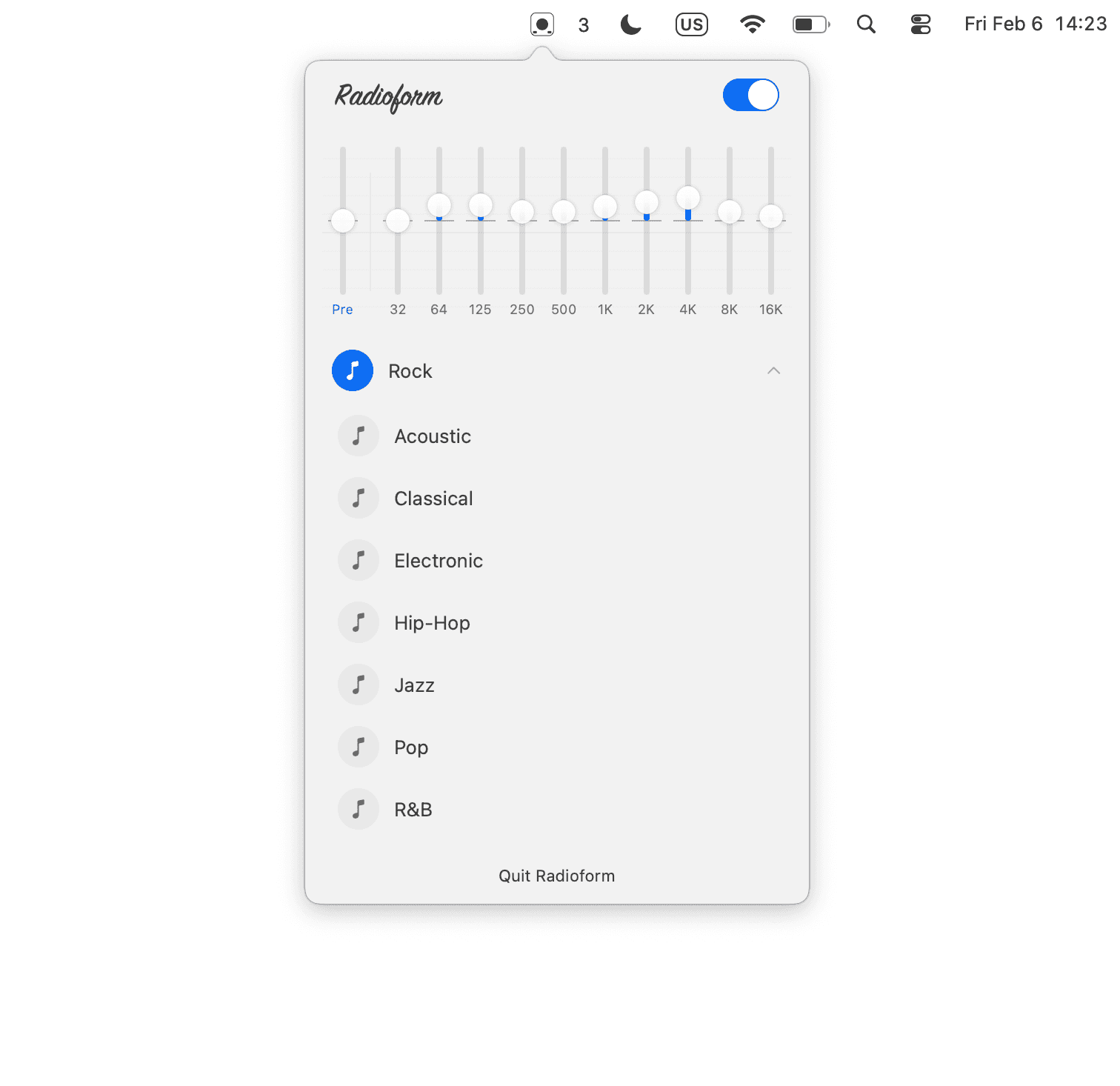
Radioform is a system-wide equalizer for macOS. It sits between your apps and your speakers and lets you change how everything sounds. Spotify, SoundCloud, FaceTime, games. If your Mac plays it, Radioform can shape it.
It works by slipping a virtual output device into CoreAudio.
It runs from your menu bar. Pick a preset or move the sliders yourself, then leave it alone. That's the whole point.
What you can do
Ten bands, 32 Hz to 16 kHz. Boost the low end. Pull back harsh highs. Add a little warmth. It works on everything your Mac plays, so there is nothing to set per app. Each band is a biquad filter. You set the gain and the Q.
There are presets if you don’t want to think about it. Electronic, Acoustic, Classical, Hip-Hop, Pop, R&B, Rock, and a Flat baseline. Good starting points. Or save your own curve and name it after the headphones you made it for.
Switch devices without restarting. AirPods, desk speakers, the living room setup. Radioform follows your output and keeps your EQ on. The sample rate sorts itself out.
There is a built-in limiter. Push the EQ hard and the limiter and preamp catch the clipping before it happens. You can go heavy without the distortion.
Under the hood
Radioform installs a virtual audio device on your Mac. All system sound passes through it, gets processed by the EQ engine, and goes on to your real speakers or headphones.
You won't hear a delay. You'll just notice things sound better.
The driver writes to shared memory. The host reads it, runs the EQ, and sends it on.
Performance
Under 1% CPU on Apple Silicon. No delay you can hear. Ten bands, 32 Hz to 16 kHz.
The DSP runs in its own process with buffers set up ahead of time.
Built with
The audio engine is C++. The app is native Swift and SwiftUI, not Electron or a web wrapper. It plugs straight into macOS CoreAudio, so it feels like something that should have shipped with the OS.
The driver, the host, and the UI are separate pieces. Each does one job.
Compatibility
macOS 13.0 Ventura or later.
Runs on Apple Silicon and Intel. Releases are signed and notarized by Apple. Updates come through Sparkle.
Open source under GPLv3. Free, no subscription, no data collection. It's just an EQ.